 Jose Rodriguez
 EDINBURG – According to the U.S. Energy Information Administration, since the recent conflict with Iran and the U.S., oil prices have risen to inflationary costs in Texas.
According to Gautam Hazarika, UTRGV’s Department Chair of economics, predicts that the cost of an oil barrel can reach $180.
Hazarika said that students who rely on their personal vehicle to get to the Edinburg and Brownsville campuses will feel the negative effects in their wallets, linking a direct relationship between gas prices and travel dependency.
“The more dependent you are on your car, the harder you are hit by rising gas prices,” Hazarika said. “So, unfortunately, the valley is not very well served by public transportation.”
He also warned about the cost of diesel fuel used to transport goods, which could lead to higher prices in store shelves increasing the cost of living for UTRGV students.
Cristin Vela, an applied statistics and data science graduate student, lives in Rio Grande City and said she drives to the Edinburg campus three times a week, adding up to two and a half hours per trip.
“It’s been rough,” Vela said. “Like, it’s really expensive because, before, I think I would spend an average of, like, $250 of gas a month, and now I spend like, around $280.”
Vela said she had to adjust her budget by cancelling her online subscriptions and reducing spending when it comes to certain items in grocery stores.
Vela considered taking public transit but did not want to wake up early to take the bus.
“So, the round trip is two hours and a half for a day, and I multiply it times three, that’s like what about 7.5? And then I do that four times a month for every week,” Vela said. “So, it’s around $250 – $280 and that range.”
Kaitlyn Polvado, a communications junior, lives close to the Edinburg campus and has a part time job at Domino’s Pizza and drives to work after school.
Polvado said she doesn’t see high gas prices affecting her student life but can definitely see it happen to students who drive from Edinburg to Brownsville.
“I’m lucky that I have a steady job and I live so close,” Polvado said. “But people that don’t live that close, it’s tough, people commuting from like Alamo or like San Juan. I mean, I wish they were going down.”
Polvado said she also had to cut corners and spend less on groceries such as dairy products to save for gas.
“It’s not like your salary is going up,” Polvado said. “You’re still getting paid the same amount, but you’re paying way more for everything. And not just gas. It’s everything.”
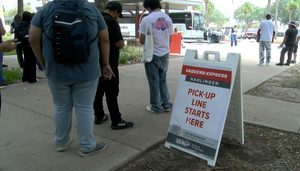
Vaquero Express still offers free transportation for UTRGV students in Edinburg, Brownsville, Harlingen, Rio Grande City and Weslaco.